I've been wandering early and late too. Ain't gonna stop soon either.
The Darling Downs is a farming region on the western slopes of the Great Dividing Range in southern Queensland.

A section of the western downs lies over coal deposits of the Surat Basin. The large mature sedimentary Surat Basin formed in the interior of the Australian continent with deposition occurring from the Early Jurassic to the earliest Cretaceous (ca 100-180mya) and reaching its peak in the Aptian period. It occupies 300,000 km2 (about the size of the Philippines) of central southern Queensland and central northern New South Wales.
The exploitation of coal seam gas (CSG) in the Surat Basin (and the adjoining Bowen Basin on its north) is a fast expanding industry these times. CSG extraction is the main game for up to eight pipelines projects. The project I’m involved in includes a 540km buried pipeline network from inland Surat to Gladstone on the pacific coast.

The present landscape of the downs is dominated by rolling hills, pastures and broad-acre farms.

These farms are planted to different vegetables, fruits cereals and other crops including cotton, wheat, etc. There are long stretches and networks of roads, bushy ridges, winding creeks, irrigation systems and forests.
 There are farms with beef and dairy cattle, pigs, sheep and lamb stock.

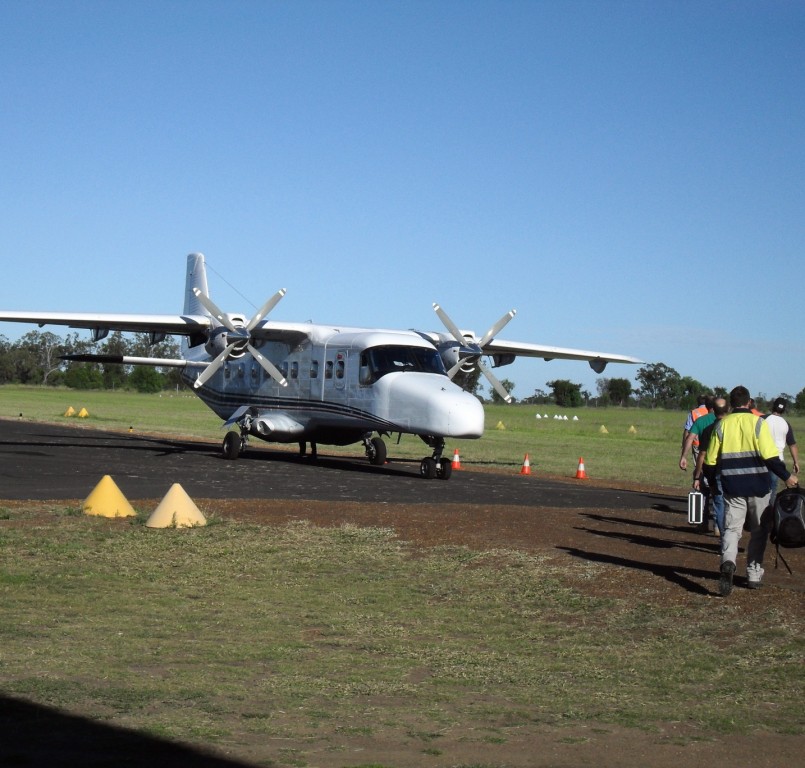
My second stint in the gasfields this year commenced a couple of weeks ago. Again we flew into Chinchilla by charter flight from Brisbane. After picking up a hire car we drove to camp in the mid-afternoon where we almost hit a kangaroo. Camp was booked out so we had to travel miles and miles to – Miles.
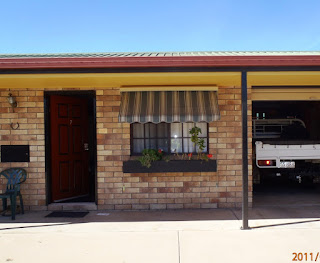
Miles outback motel was our base for a week while working in a few sites in the west of Wandoan.
At day’s end while my colleagues enjoy a pint of beer or drop of ale, I would retire to a sip of my new favourite drink. I gave up on white red black green or other labels. My new drink of choice is - blue label.

Each night after dinner and during paperwork, I would easily gulp down two or three mugs of this. I’ll need bushels of supplies.
Wandoan, 65km from Miles, is the ideal base for our worksites but all accommodation there have been booked for the next few months. So daily we zoomed up to beyond the hills of the great dividing range.

Our worksites are in the gasfields west of Wandoan. These areas are on rolling hills and backwoods in the boondocks to the north of the great dividing range, situated in the parishes of Juandah, Golden, Rochedale, carraba, hinchley; and in the Counties of Fortescue and Aberdeen.

Sited on the Leichhardt highway between Miles and Taroom, Wandoan was first surveyed in 1902. Wandoan became a rail terminus but by the 1930s more land, up to 60 kms outside town, was opened for closer-settlement.

We worked around the localities of Grosmont, Wandoan, Bundi, Clifford, Woleebee.

We also drove through Guluguba, Gurulmundi, Waikola, Eurombah and parts of the towns of Roma in Maranoa and Taroom in Banana. Some of our worksites are Accrux, Charlie, Polaris, Cam, Phillip, Kathleen and Thackery.

I examined some historical documents for a bit of context. The bigger central towns were opened for settlement soon after the explorer Ludwig Leichhardt first came through in 1844. Documents dating back to the 1850s describe the region variously: brigalow and other scrub very dense in places thick undergrowth with patches of vines foxbush sandalwood scattered pear impenetrable box grassed wilga timber vine scrub tanglefoot brigalow and belar scrub bauhinia box yarran turkeybush clumpy brigalow cypress myrtle bottle softwood brigalow and wilga currant bush, ironbark large areas pulled ringbarked brigalow regrowth forests cultivation.

The country here was originally brigalow eucalypt woodland and grassland but are now mostly crop farms and cattle grazing lands and state forests. The uncultivated land is still eucalypt woodland open acacia and casuarina forests with rainforest and evergreen vine thickets and gurulmindi heath-myrtle and myall woodlands and bluegrass. The undulating landscape is crisscrossed by dusty country roads alluvial floodplains and numerous creeks (at least 10 have names) that make many towns and homesteads inaccessible during rainy seasons.

The cleared paddocks contain grasslands and wattle. Patches of remnant vegetation still hold out. Brigalow forests are considered under threat. Some 800 plant species and 400 animal species have been identified around here.

Bottle trees are a feature in these parts.
Travelling around these parts we see local fauna: wild pigs, wild dogs, red foxes, various roadkill, rabbits, turtles, frogs etc. I also found this little beauty - a brigalow scaly foot under a log. This reptile mimics a snake perhaps for defense, and is mistaken for a snake. It is in fact a legless lizard.

Cruising home one afternoon we came upon a turtle with a neck as long as its shell crossing the road. I had to swerve as it stopped and ducked its head in its shell.
On the same trip, we passed a lizard slowly moving along the edge of road. I would have thought it was hitch-hiking.
Another time I saw a a 5-ft brown or black reptile. "It was smooth as glass, slithering through the grass. I saw it dissappear near a lake - Ah, ' think I'll call it a snake."

Various birdlife finch pigeon goshawk emus ducks red and grey galahs white cockatoos and brolgas green parrots brush turkeys jack sparrows wedge-tail eagles.
Many small birds end up as road kill when they tempt fate flying off at the last moment when cars approach.
More than 10 Migratory bird species: eagles, needletail, bee-eater, egrets, snipes, swift and geese, stop over in these parts.
After a week of working out of Miles, we were informed that our booking had ran out and had to move base. This business of ‘no room at the inn’ has been a bane to travellers since Joseph and Mary’s times. We rang around and eventually reached Taroom where we found room - ta, or thanks as they say colloquially down under (and in Britain). We moved base miles and miles from Miles (about 75 miles) to camp with cattle in Taroom.

I’ll clarify that – we checked in at the cattle camp motel in Taroom.
Our new base is almost equidistant to our worksites from our previous base in Miles. But now the Roma-Taroom road is our main route.
The countryside north of Taroom abounds in natural attractions, but I prefer the ‘interesting’ to the ‘attractive’. The large Coolibah tree on which Leichhardt carved his initials in 1844 still stands in the main street.

The Dawson River has many fishing spots, but I checked out the Taroom riverwalk instead. Taroom’s unique ‘Steel Wings’ windmill is one of only two known working examples in the world.
Once I deployed to the greener more picturesque hills around Woleebee creek.

This place, a remnant rainforest area, is as good as it gets around here. The dusty twisting and turning Country roads remind of home.

One time I went bushwalking around some Brigalow tree stands. Along the ground were some fossil material - shards of petrified wood which I thought were broken terracotta vases. I also kicked at what looked like a piece of timber, but instead stubbed my toe on what was a fine specimen of timber fossil. There is a great display of more than 5000 geological specimens of petrified Australian forests in Miles adjudged to be the best in the world. I did not see this attraction in Miles but I did explore ‘Dogwood Crossing’ and sighted the many turn-of-the-century buildings in the Historical Village.

Deep in the bush we found a couple of ooline trees, remnants of an ancient rainforest. One, a giant 25-metre high Ooline, had a big 2-3 metre eagle’s nest in it. My ecologist companion estimates the nest as approximately 20 yrs old and perhaps repaired every year by its resident. It's a privilege to sight a rare gigantic Ooline - a proud survivor from ancient times, when this area was a lush green rainforest.

Often we meet herds of cattle on the tracks. One time we had a mob of kangaroos and a herd of cows race alongside our car for a couple of hundred meters. I would not have believed that had I not seen it.

Along the highway too are beasts of another kind. Once on a lonesome stretch of dusty Goldens road we meet this beast.

Another time on the Leichhardt heading south to Wandoan, we had to get off the road for a big tray being transported to the mines.

In these two weeks in the gasfields we traversed many a long and lonesome dusty road. From the Leichhardt highway, to the Roma-Taroom road, to the Crossroads Road near north Jackson, and every rough back country road and creek crossing in between.
I befriended a green frog, but it hopped off. It did not like the sunshine one bit.

On the homebound journey at stint’s end, good drenching rains greet us as we approach Condamine just after leaving Miles. Thankfully the creeks were not swollen.
ps we'll hear from dubya next blog.
The Darling Downs is a farming region on the western slopes of the Great Dividing Range in southern Queensland.

A section of the western downs lies over coal deposits of the Surat Basin. The large mature sedimentary Surat Basin formed in the interior of the Australian continent with deposition occurring from the Early Jurassic to the earliest Cretaceous (ca 100-180mya) and reaching its peak in the Aptian period. It occupies 300,000 km2 (about the size of the Philippines) of central southern Queensland and central northern New South Wales.
The exploitation of coal seam gas (CSG) in the Surat Basin (and the adjoining Bowen Basin on its north) is a fast expanding industry these times. CSG extraction is the main game for up to eight pipelines projects. The project I’m involved in includes a 540km buried pipeline network from inland Surat to Gladstone on the pacific coast.

The present landscape of the downs is dominated by rolling hills, pastures and broad-acre farms.

These farms are planted to different vegetables, fruits cereals and other crops including cotton, wheat, etc. There are long stretches and networks of roads, bushy ridges, winding creeks, irrigation systems and forests.


My second stint in the gasfields this year commenced a couple of weeks ago. Again we flew into Chinchilla by charter flight from Brisbane. After picking up a hire car we drove to camp in the mid-afternoon where we almost hit a kangaroo. Camp was booked out so we had to travel miles and miles to – Miles.

Miles outback motel was our base for a week while working in a few sites in the west of Wandoan.
At day’s end while my colleagues enjoy a pint of beer or drop of ale, I would retire to a sip of my new favourite drink. I gave up on white red black green or other labels. My new drink of choice is - blue label.

Each night after dinner and during paperwork, I would easily gulp down two or three mugs of this. I’ll need bushels of supplies.
Wandoan, 65km from Miles, is the ideal base for our worksites but all accommodation there have been booked for the next few months. So daily we zoomed up to beyond the hills of the great dividing range.

Our worksites are in the gasfields west of Wandoan. These areas are on rolling hills and backwoods in the boondocks to the north of the great dividing range, situated in the parishes of Juandah, Golden, Rochedale, carraba, hinchley; and in the Counties of Fortescue and Aberdeen.

Sited on the Leichhardt highway between Miles and Taroom, Wandoan was first surveyed in 1902. Wandoan became a rail terminus but by the 1930s more land, up to 60 kms outside town, was opened for closer-settlement.

We worked around the localities of Grosmont, Wandoan, Bundi, Clifford, Woleebee.
We also drove through Guluguba, Gurulmundi, Waikola, Eurombah and parts of the towns of Roma in Maranoa and Taroom in Banana. Some of our worksites are Accrux, Charlie, Polaris, Cam, Phillip, Kathleen and Thackery.

I examined some historical documents for a bit of context. The bigger central towns were opened for settlement soon after the explorer Ludwig Leichhardt first came through in 1844. Documents dating back to the 1850s describe the region variously: brigalow and other scrub very dense in places thick undergrowth with patches of vines foxbush sandalwood scattered pear impenetrable box grassed wilga timber vine scrub tanglefoot brigalow and belar scrub bauhinia box yarran turkeybush clumpy brigalow cypress myrtle bottle softwood brigalow and wilga currant bush, ironbark large areas pulled ringbarked brigalow regrowth forests cultivation.

The country here was originally brigalow eucalypt woodland and grassland but are now mostly crop farms and cattle grazing lands and state forests. The uncultivated land is still eucalypt woodland open acacia and casuarina forests with rainforest and evergreen vine thickets and gurulmindi heath-myrtle and myall woodlands and bluegrass. The undulating landscape is crisscrossed by dusty country roads alluvial floodplains and numerous creeks (at least 10 have names) that make many towns and homesteads inaccessible during rainy seasons.


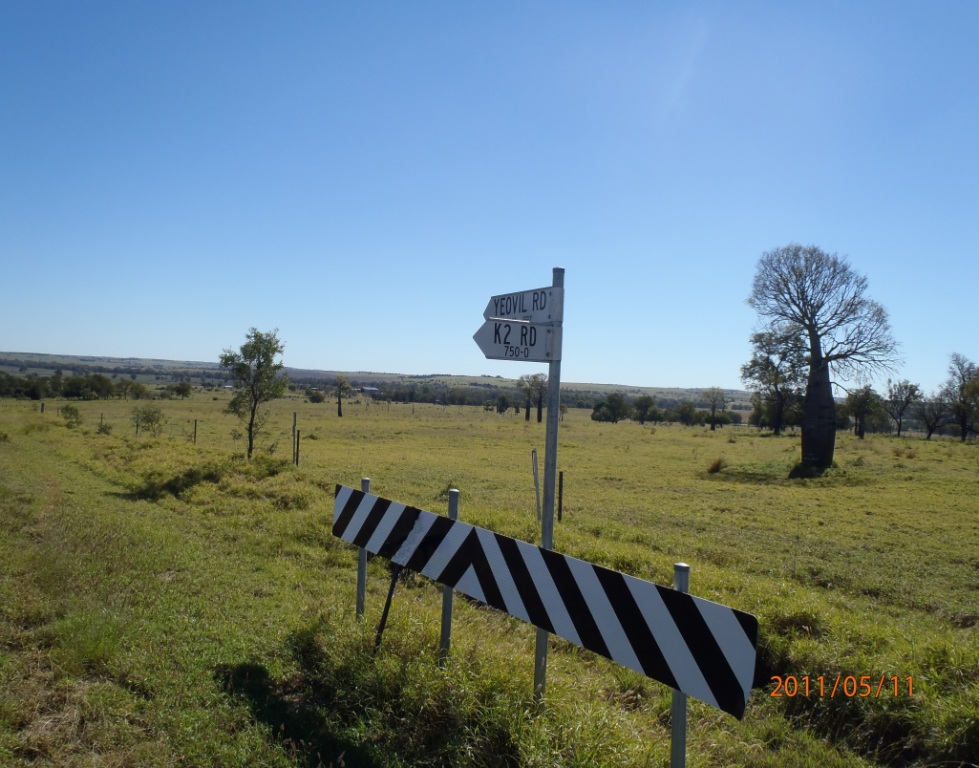
Bottle trees are a feature in these parts.
 |
| A bottle tree dwarfs cars in the skyline in the background. |

Cruising home one afternoon we came upon a turtle with a neck as long as its shell crossing the road. I had to swerve as it stopped and ducked its head in its shell.
On the same trip, we passed a lizard slowly moving along the edge of road. I would have thought it was hitch-hiking.
Another time I saw a a 5-ft brown or black reptile. "It was smooth as glass, slithering through the grass. I saw it dissappear near a lake - Ah, ' think I'll call it a snake."

Various birdlife finch pigeon goshawk emus ducks red and grey galahs white cockatoos and brolgas green parrots brush turkeys jack sparrows wedge-tail eagles.
Many small birds end up as road kill when they tempt fate flying off at the last moment when cars approach.
 |
| A red and grey galah roadkill. |
 |
| Keeping an eagle eye on things. |

I’ll clarify that – we checked in at the cattle camp motel in Taroom.
Our new base is almost equidistant to our worksites from our previous base in Miles. But now the Roma-Taroom road is our main route.
The countryside north of Taroom abounds in natural attractions, but I prefer the ‘interesting’ to the ‘attractive’. The large Coolibah tree on which Leichhardt carved his initials in 1844 still stands in the main street.

The Dawson River has many fishing spots, but I checked out the Taroom riverwalk instead. Taroom’s unique ‘Steel Wings’ windmill is one of only two known working examples in the world.
Once I deployed to the greener more picturesque hills around Woleebee creek.

This place, a remnant rainforest area, is as good as it gets around here. The dusty twisting and turning Country roads remind of home.

One time I went bushwalking around some Brigalow tree stands. Along the ground were some fossil material - shards of petrified wood which I thought were broken terracotta vases. I also kicked at what looked like a piece of timber, but instead stubbed my toe on what was a fine specimen of timber fossil. There is a great display of more than 5000 geological specimens of petrified Australian forests in Miles adjudged to be the best in the world. I did not see this attraction in Miles but I did explore ‘Dogwood Crossing’ and sighted the many turn-of-the-century buildings in the Historical Village.

Deep in the bush we found a couple of ooline trees, remnants of an ancient rainforest. One, a giant 25-metre high Ooline, had a big 2-3 metre eagle’s nest in it. My ecologist companion estimates the nest as approximately 20 yrs old and perhaps repaired every year by its resident. It's a privilege to sight a rare gigantic Ooline - a proud survivor from ancient times, when this area was a lush green rainforest.

 |
| A smaller bird has a nest on the same Ooline tree. |

Along the highway too are beasts of another kind. Once on a lonesome stretch of dusty Goldens road we meet this beast.

Another time on the Leichhardt heading south to Wandoan, we had to get off the road for a big tray being transported to the mines.

In these two weeks in the gasfields we traversed many a long and lonesome dusty road. From the Leichhardt highway, to the Roma-Taroom road, to the Crossroads Road near north Jackson, and every rough back country road and creek crossing in between.
 |
| Riverwalk in Taroom. |
 |
| froggy went a-posting. |

On the homebound journey at stint’s end, good drenching rains greet us as we approach Condamine just after leaving Miles. Thankfully the creeks were not swollen.
ps we'll hear from dubya next blog.